

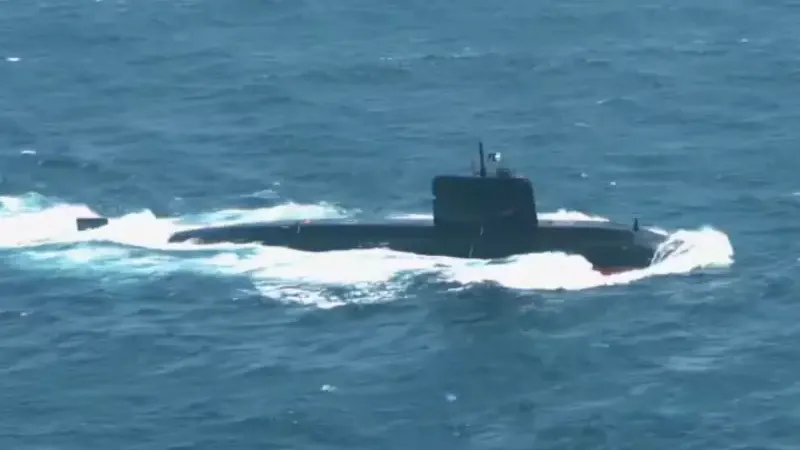
The Pakistan Navy’s first Hangor-class submarine has successfully conducted its first live weapon firing in the Arabian Sea, striking a long-range target with an anti-ship cruise missile, the military’s media wing, Inter-Services Public Relations (ISPR), said on Sunday.
ISPR described the exercise as a “major demonstration of operational readiness” for the newly inducted PNS/M HANGOR, which arrived at Karachi Port in June.
A direct hit at long range
According to ISPR, the submarine “accurately engaged a designated long-range target with an anti-ship cruise missile” during the firing exercise.
The Chief of the Naval Staff, Admiral Naveed Ashraf, witnessed the firing. He praised the submarine’s combat power and stressed the “strategic importance of enhancing subsurface capabilities for credible maritime deterrence”.
“The milestone underscores the Pakistan Navy’s commitment to maintaining a modern, combat-ready force to safeguard national maritime frontiers and regional peace,” ISPR said.
Eight submarines, built with China
PNS Hangor is the first of eight Hangor-class submarines the navy is set to induct, in a programme that reflects the deepening defence cooperation between Pakistan and China.
The first submarine was launched in China in April 2024. The second, third and fourth were launched in March, August and December 2025 respectively.
The Hangor class is equipped with advanced combat systems, modern sensors and enhanced stealth features. It also uses Air Independent Propulsion (AIP), a technology that allows conventional submarines to stay submerged far longer than older designs, making them harder to detect and significantly increasing the navy’s ability to operate undetected.
A name with history
The name carries special weight in Pakistan’s naval history. During the 1971 war with India, the original PNS Hangor became the first submarine since the Second World War to sink a warship, when it sank the Indian frigate INS Khukri.
Why it matters for Pakistan
Pakistan’s economy depends heavily on the sea. Most of its trade passes through Karachi and Port Qasim, and Gwadar is central to its long-term connectivity plans. With tensions high in the region, from the Gulf to the Arabian Sea, a modern submarine force is a key part of the navy’s ability to protect shipping lanes and deter threats.
The firing comes as Pakistan has placed maritime security high on its diplomatic agenda. At the UN General Assembly this week, Prime Minister Shehbaz Sharif called for key sea lanes such as the Strait of Hormuz to remain open, describing them as “arteries of the global economy”.
The regional balance
The new submarines also add to the naval balance in the Indian Ocean. India’s own navy faces shortfalls, operating 15 to 16 conventional submarines against a stated requirement of at least 24, according to a recent analysis of India’s military readiness. The Hangor programme gives Pakistan a significantly more capable underwater fleet as the remaining seven submarines join over the coming years.
What’s next
With the first submarine now proven in a live firing, attention will turn to the induction of the remaining boats. Each new submarine will strengthen the navy’s ability to maintain a continuous presence at sea, a cornerstone of what Admiral Ashraf called “credible maritime deterrence”.
This article draws on a statement by ISPR, as reported by Dawn.




Comments
Comments are reviewed by our editors before they appear. Please keep them civil and on topic. See our terms.
No comments yet. Be the first to share your view.