
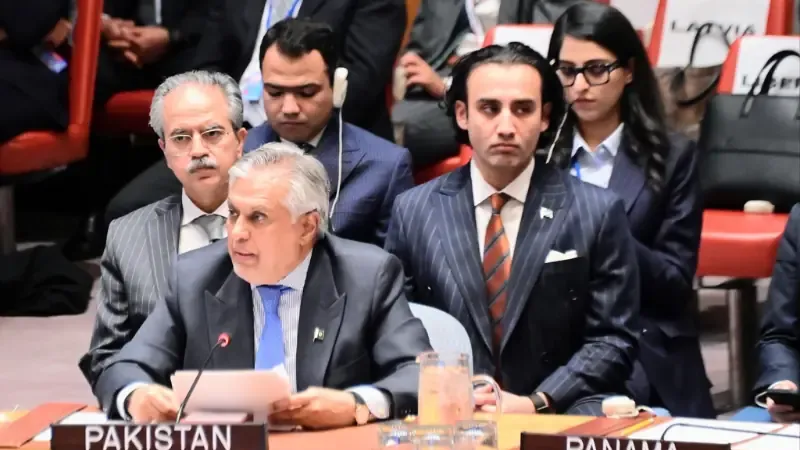
Pakistan has urged the world to stop artificial intelligence from becoming “another facet of the ongoing arms race”, as the UN Security Council heard directly from the leaders of some of the world’s most prominent AI companies.
Deputy Prime Minister and Foreign Minister Ishaq Dar delivered Pakistan’s statement at a France-chaired Security Council briefing on artificial intelligence and international security in New York. The council was also briefed by OpenAI chief executive Sam Altman, Anthropic chief executive Dario Amodei, Hugging Face chief executive Clément Delangue and Yoshua Bengio, co-chair of the UN’s International Independent Panel on AI.
Pakistan’s message: guardrails and human control
Dar called for “concerted efforts” to put in place guardrails, regulations and governance frameworks for AI. In the military domain specifically, he said, countries need measures of restraint and confidence-building to reduce the risk of miscalculation and of decisions being made too quickly.
According to his remarks, shared by the Foreign Office, the “foremost priority” should be to keep human judgement and control at every stage of AI design, development and deployment, including setting limits on the speed and nature of future capabilities.
He warned that AI was “supercharging” existing threats, including misinformation, fake news and cyber attacks on critical infrastructure by both states and non-state groups.
Safety must not become gatekeeping
Dar welcomed the growing recognition that no single company or country can manage AI’s risks alone. But he also sounded a warning of particular relevance to developing countries: efforts to slow the AI frontier “must not become a new form of gatekeeping”, and measures taken in the name of safety must not be used to deny technology to others.
Decisions on managing AI risks, he said, “cannot rest with a handful of companies or capitals”. He argued against fragmented or exclusive forums and called for AI governance to be handled in representative, inclusive bodies under the UN’s umbrella. He pointed to two recent initiatives as positive steps: the UN’s first Global Dialogue on AI Governance, held in Geneva, and the World Artificial Intelligence Cooperation Organisation, of which Pakistan is a founding member. It is a theme Pakistan has pressed across the UN this week, as our editorial on the UN’s role argues.
What the tech leaders said
The briefing was notable for the presence of the AI industry itself. Altman told the council that the moment “calls for extreme care”, warning that as AI systems become more capable and autonomous they could outpace institutions or concentrate power in too few hands. He urged governments to cooperate with each other and with industry, saying his company would try to steer a “middle path” between blind optimism and “doomerism”.
Amodei, speaking by video, said more powerful models would require even stricter safety standards, and that Anthropic would “slow down as much as necessary” to make sure each new system it releases is safe. He warned that, if managed poorly, AI could pose a risk to humanity as a whole.
Delangue argued that open-source AI was more important than ever, noting that his company had itself been targeted by AI-enabled attacks and had used AI to defend against them.
A split over regulation
The meeting also exposed differences among major powers. French Foreign Minister Jean-Noël Barrot called for joint action through the UN and with companies to set rules for the new era. But Michael Kratsios, director of the White House Office of Science and Technology Policy, said rapid progress was not a reason to pause AI development or to constrain it with new governance structures, reflecting the Trump administration’s resistance to calls for a slowdown.
Why it matters for Pakistan
For Pakistan, the debate is about more than security. The country is trying to build a technology workforce and expand IT exports, and its concern that “safety” rules could turn into barriers to access reflects a wider worry among developing countries about being shut out of a technology that will shape economic growth. At the same time, as a nuclear-armed state in a tense neighbourhood, Pakistan has a direct interest in rules that stop AI from speeding up military decision-making.
Reporting draws on accounts published by Dawn and AFP, and statements from Pakistan’s Foreign Office.


Comments
Comments are reviewed by our editors before they appear. Please keep them civil and on topic. See our terms.
No comments yet. Be the first to share your view.